
Main Courses
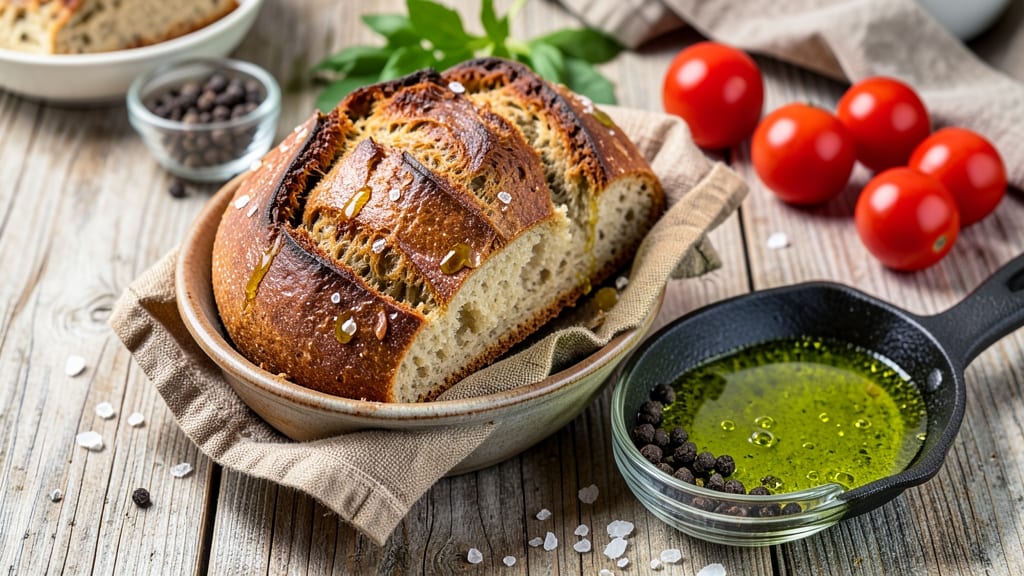
This artisan bread recipe with flavors transforms your kitchen into a rustic bakery with every batch. 🔥 The secret lies in high hydration dough that develops a crispy crust and airy crumb—no fancy equipment needed.
I’ve perfected this method after years of trial and error, and it’s the base for endless flavor variations from classic to creative.
The magic happens during slow fermentation, where the dough develops depth and structure. You’ll knead, let it rise twice, then shape into beautiful boules or batards before baking with steam for that perfect golden crust.
The recipe includes optional additions like herbs, seeds, or honey for customization, but the base alone delivers restaurant-quality results.
What you’ll end up with is bread that’s crunchy on the outside, soft and chewy inside, and packed with that fresh-baked aroma that fills your whole house. The scoring technique ensures even oven spring, and the steam creates that coveted crackly crust that’s impossible to resist.
Whether you’re baking for a crowd or just treating yourself, this recipe scales beautifully. Master the base first, then experiment with flavors—each loaf will be better than the last. Let’s get started on your artisan bread journey!
Ingredients for artisan bread recipe flavors
Four cups of flour kickstart this flavor-forward artisan journey—where crusty bites meet endless customization possibilities.
| Ingredient | Amount | Notes |
|---|---|---|
| All-Purpose Flour 🌾 | 4 cups | High-protein preferred for structure |
| Active Dry Yeast 🍞 | ¼ oz | Or 2.25 tsp packet fresh yeast |
| Granulated Sugar 🍚 | ½ tsp | Feeds yeast for activation |
| Salt 🧂 | 1 ½ tsp | Diamond Crystal preferred |
| Water 💧 | 1 ¾ cups | Room temperature, 70°F |
| Extra-Virgin Olive Oil 🫒 | ¼ cup | For dough enrichment |
| Honey 🍯 | 1 tbsp | Optional for sweetness |
| Fresh Rosemary 🌿 | ¼ cup | Finely chopped, optional |
| Coarse Sea Salt 🧂 | 2 tbsp | For crust enhancement |
| Poppy Seeds 🌰 | 1 tbsp | Optional for texture |
| Sesame Seeds 🌻 | 1 tbsp | Optional for crunch |
| Cornmeal 🌽 | ¼ cup | For dusting baking sheets |
| Ice Cubes ❄️ | ½ cup | For creating steam |
Flour is the foundation, so King Arthur or Caputo make all the difference—they handle high hydration better than store brands. Yeast quality matters too: Saf-Instant is my go-to for reliability, but fresh yeast works if you activate it in warm water with sugar first. Rosemary? Trader Joe's sells it pre-chopped, but fresh is worth the extra minute. For the honey, Manuka or clover adds subtle depth—avoid the cheap grocery store kind. The olive oil should smell fruity and peppery, not stale. If you're short on time, store-bought dough discs can be shaped and baked with these flavor additions.
No rosemary? Thyme or oregano work beautifully—just halve the amount. Skip honey? Maple syrup or agave keeps it vegan. For seeds, nutritional yeast adds a cheesy note if you're avoiding dairy. The coarse salt? Maldon or Jacobsen flakes dissolve perfectly into the dough. Pro tip: toast your seeds in a dry pan for 2 minutes before mixing—they'll add even more crunch. If your dough feels too sticky, add flour 1 tbsp at a time, but don't overdo it or you'll lose that signature chew.
Dough keeps 24 hours in the fridge, wrapped tightly in plastic. For longer storage, freeze shaped loaves (unbaked) for up to 3 months—thaw overnight before baking. The cornmeal layer prevents sticking, but semolina works too for extra crunch. That ice cube trick? It's non-negotiable for steam—place cubes on baking sheets before adding dough. Leftovers? Toast slices for 2 days with perfect crispiness. The crust freezes beautifully too—just reheat in a 350°F oven for 5 minutes to revive that bakery-fresh aroma.
Why You'll Love This Recipe
- I’ll be real: I almost always bake two batches. The first disappears in a day, but the second? It freezes like a dream, ready to revive with a quick toast in the morning. Zero waste, zero guilt, just pure, fresh bread whenever you need it.
- Five-Ingredient Magic: I swear, this bread starts with nothing but flour, yeast, sugar, salt, and water—and somehow ends up tasting like a bakery loaf. That’s the beauty of letting the yeast do the work while you mix, knead, and shape in under 20 minutes. No fancy ingredients, no stress.
- Crust That Cracks: Honestly, the moment that golden crust forms with a satisfying snap? That’s when you know you’ve hit the jackpot. The sugar caramelizes just enough to give it a subtle sweetness, while the salt keeps every bite balanced—simple, but ridiculously satisfying.
- Weeknight or Weekend: Between us, this bread is my secret weapon for lazy Sundays and last-minute dinner guests. Toss in a few rosemary sprigs or a pinch of cinnamon for holidays, or keep it plain for toast—it’s the one loaf that works for everything without extra fuss.
Step-by-step instructions for flavor-forward artisan bread
Transform simple dough into aromatic, crusty masterpieces with these precise techniques.
👨🍳 Step 1: Activate the Yeast and Mix the Dough
In a large bowl, combine the 1.75 cups water, 0.5 tsp granulated sugar, and 0.25 oz active dry yeast. Let sit for 5-10 minutes until foamy—this confirms your yeast is alive and ready to work. If it doesn't bubble, start over with fresh yeast.
In a separate bowl, whisk together the 4 cups all-purpose flour and 1.5 tsp salt. Create a well in the center and pour in the yeast mixture along with the 0.25 cup extra-virgin olive oil and 1 tbsp honey. Mix with a wooden spoon until a shaggy dough forms. Here's the thing—don't overwork it yet. We'll develop the gluten properly during kneading.
🥘 Step 2: Knead Until Smooth and Elastic
Turn the dough onto a lightly floured surface and knead for 8-10 minutes by hand, or use a stand mixer with a dough hook on medium speed for 5-6 minutes. You're looking for a dough that's smooth, elastic, and springs back slowly when poked. This develops the gluten network that gives artisan bread its signature chew.
I like to do the "windowpane test" during kneading: stretch a small piece of dough thin enough to see light through it. If it tears, keep kneading. If it holds without tearing, you're good. Real talk: this step makes or breaks your bread's texture—don't skip it.
⏰ Step 3: First Rise with Rosemary Infusion
Place the dough in a lightly oiled bowl, cover with a damp towel, and let rise in a warm place (75-80°F) for 1-2 hours or until doubled in size. Here's where we add our flavor: sprinkle the 0.25 cup finely chopped fresh rosemary evenly over the dough, then gently press it in so it's distributed throughout.
Don't worry if the rosemary doesn't fully incorporate—some will stay on top, creating beautiful aromatic pockets when baked. This is the moment that matters: the dough should be light and airy, with just a few small bubbles on the surface. If it rises too quickly, your oven might be too warm—adjust accordingly.
🔥 Step 4: Shape and Second Rise with Seed Topping
Punch down the dough to release air, then divide into 4 equal portions (about 1 pound each). Shape each into a round boule by pulling the edges toward the center and sealing the seam. Place on a parchment-lined baking sheet dusted with 0.25 cup cornmeal.
Cover and let rise again for 30-45 minutes until puffy. Before baking, create your seed topping by mixing the 1 tbsp poppy seeds, 1 tbsp sesame seeds, and 2 tbsp coarse sea salt. Sprinkle generously over each boule—this will create a stunning, crunchy crust with each bite.
🔥 Step 5: Bake with Steam for Maximum Crust
Preheat your oven to 450°F with a Dutch oven inside for 30 minutes. Carefully transfer the boules (with parchment) into the hot Dutch oven. Add 0.5 cup ice cubes to create steam—this is crucial for that iconic artisan bread crust.
Bake covered for 20 minutes, then remove the lid and bake 10-15 minutes more until the crust is deep golden brown and sounds hollow when tapped on the bottom. The interior temperature should reach 190-200°F. Let cool on a wire rack for at least 30 minutes—this prevents a gummy interior and lets those flavors develop fully.
Pro Tips For Making Artisan Bread Recipe Flavors
- Use Lukewarm Water: I learned this the hard way—yeast hates extremes. Fill your water to about 110°F (43°C) or just warm enough to touch without feeling hot. Too hot kills the yeast, too cold makes it sluggish, and neither gives you that light, airy texture you’re after.
- Dissolve the Sugar First: Mix the granulated sugar into the water before adding yeast—this speeds up activation and gives your dough a head start. I used to sprinkle it in later, and the rise was always slower. A few extra minutes here means a better oven spring later.
- Knead Until Windowpane: Test your dough’s readiness by stretching a small piece—if it’s thin enough to see light through (like a window), it’s done. Over-kneading dries it out; under-kneading makes it dense. This is the thing that matters most for that professional crumb.
- Salt the Water: Yes, even if the recipe calls for salt later—dissolve half the salt in the water upfront. It helps control yeast activity and distributes flavor evenly. I was skeptical until I tried it, and now I can’t go back.
Creative variations of this dish
Herb-Infused Classics
Swap the rosemary for 1 tbsp fresh thyme or 1 tbsp chopped oregano for Mediterranean vibes. For a French twist, add 1 tsp dried lavender buds (steeped in warm water for 10 minutes first) and 1 tsp fennel seeds—this creates an elegant, floral aroma.
I once made a savory rosemary-garlic version by mixing 2 tbsp minced garlic into the dough before shaping. 🌿
Sweet & Savory Twists
Add 2 tbsp blackstrap molasses or 1 tbsp maple syrup to the dough for a caramelized crust. Top with 1 tbsp crushed walnuts and 1 tsp cinnamon before baking for a sweet loaf perfect with breakfast.
For a cheesy kick, fold ½ cup shredded Gruyère into the dough after the first rise—it melts beautifully during baking. 🍯
Global Flavor Journeys
Transform this into Italian focaccia by shaping into a flat rectangle, dimpling with your fingers, and topping with 2 tbsp olive oil, 1 tbsp chopped parsley, and 1 tsp flaky sea salt.
For a Mexican-inspired bolillo, add 1 tsp cumin and ½ tsp smoked paprika to the dough, then brush baked loaves with olive oil and sprinkle with sesame seeds. 🌎
Seed & Nut Crunch
Mix ¼ cup chopped pecans or ¼ cup sunflower seeds directly into the dough for texture. For a nutty loaf, replace 1 tbsp flour with 1 tbsp almond flour and top with 1 tbsp sliced almonds before baking.
I love a pumpkin seed-cranberry combo: fold in ¼ cup dried cranberries and 2 tbsp pumpkin seeds for a festive touch. 🌰
Spiced & Smoky Variations
Add 1 tsp smoked paprika and ½ tsp cayenne for a smoky kick. For a Moroccan-inspired loaf, mix 1 tsp ground cumin, ½ tsp coriander, and ¼ tsp cinnamon into the dough.
A black pepper and rosemary combo works wonders—just add 1 tsp freshly cracked black pepper to the dough and 1 tbsp cracked pepper on top before baking. ⚡
Vegan & Gluten-Free Adaptations
Replace flour with 3 cups gluten-free all-purpose blend and 1 tbsp psyllium husk powder (mixed with water first). For vegan, use nutritional yeast instead of honey and flax eggs (1 tbsp ground flax + 3 tbsp water) to bind.
I’ve had great success with a chia seed-enriched dough—add 1 tbsp chia seeds to the dough for extra fiber and omega-3s. 🌱
Nutrition facts
Frequently asked questions
What makes artisan bread different from regular bread?
Artisan bread uses higher hydration (more water) and longer fermentation times, creating a chewier texture and crispier crust. Traditional bread often contains more fat and sugar for softness, while artisan versions rely on proper kneading and slow rises for structure. The flavor is also more complex due to natural fermentation.
Can I use whole wheat flour instead of all-purpose?
Yes, but replace half the flour with whole wheat and add 1 extra tbsp olive oil—whole wheat absorbs more moisture. The texture will be denser, so reduce water slightly if needed. For best results, use King Arthur whole wheat blend which handles high hydration better than store brands.
Why did my bread turn out dense instead of airy?
This usually happens from over-kneading (breaking gluten) or underproofing (not enough rise time). Check your yeast—if it didn't foam in 5-10 minutes, it was dead. Also ensure your kitchen is 75-80°F for proper fermentation. For next time, try a cold ferment (48 hours in fridge) for better flavor development.
How do I store homemade artisan bread?
Wrap cooled loaves in beeswax wrap or a clean kitchen towel to prevent drying. Store at room temperature for 2-3 days, or freeze for up to 3 months. To revive frozen bread, warm in a 350°F oven for 5-10 minutes with foil. For longer freshness, slice and freeze individual portions.
What's the best way to reheat sliced artisan bread?
For crispy crust: wrap slices in aluminum foil and warm in a 350°F oven for 5 minutes. For toast: use a toaster set to medium heat—artisan bread toasts beautifully. Avoid microwaving as it makes the crust soggy. Pro tip: brush warm slices with olive oil and sprinkle with flaky salt for extra flavor.