
Desserts
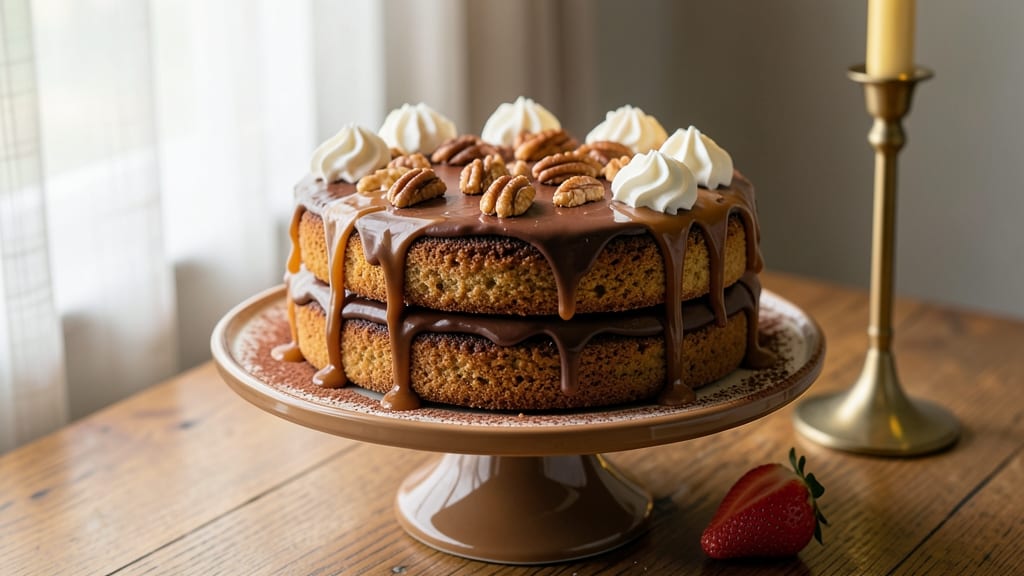
This best German chocolate cake recipe ever from scratch delivers the ultimate from-scratch experience with layers of moist cake, rich coffee-infused fudge streaks, and a velvety chocolate-coconut frosting. 💛 After perfecting this recipe through countless batches, I've cracked the code for achieving that signature texture—tender yet sturdy enough to hold the generous frosting without collapsing.
The secret lies in precise technique: using buttermilk for moisture, carefully folded egg whites for lift, and a coffee infusion that deepens the chocolate flavor without overpowering it.
Every element is made from scratch—no boxed mixes here—so you get that authentic German chocolate cake taste that's been a dessert classic for decades.
What you'll end up with is a showstopping cake with perfectly balanced layers: a tender cake base, rich chocolate-coconut frosting that's neither too sweet nor too heavy, and a pecan topping that adds satisfying crunch. The coffee-infused streaks add depth that elevates this beyond ordinary chocolate cake.
Ready in about 2 hours (including cooling time), this cake stays moist for days and tastes even better the next day. Here's how to make it from scratch—just like the German chocolate cake you've been dreaming about.
Ingredients for best german chocolate cake recipe ever from scratch
Eighteen ingredients, three layers of magic—moist cake, coffee-infused streaks, and velvety frosting that'll make you the star of any gathering.
| Ingredient | Amount | Notes |
|---|---|---|
| All-Purpose Flour 🌾 | 3 cups | Sifted for lighter texture |
| Unsalted Butter 🧈 | 1 ½ cups | Room temperature, European preferred |
| Granulated Sugar 🍚 | 2 ½ cups | Superfine preferred for smoothness |
| Light Brown Sugar 🍚 | ½ cup | Packed firmly, moist texture |
| Buttermilk 🥛 | 1 ½ cups | Room temperature for best results |
| Large Eggs 🥚 | 4 whole | Room temperature, separated |
| Pure Vanilla Extract 🌿 | 2 tsp | High-quality, no imitation |
| Instant Espresso Powder ☕ | 2 tbsp | For deep coffee flavor |
| Hot Water 💧 | ½ cup | To dissolve espresso powder |
| Semi-Sweet Chocolate Chips 🍫 | 1 ½ cups | High-quality, 60% cacao |
| Unsweetened Cocoa Powder 🍫 | ½ cup | Dutch-processed for smoothness |
| Toasted Pecans 🌰 | 2 cups | Chopped, for topping |
| Heavy Whipping Cream 🥛 | 4 cups | Cold for frosting |
| Powdered Sugar 🍚 | 4 cups | For smooth frosting |
| Shredded Coconut 🥥 | 1 cup | Sweetened, for topping |
| Salt 🧂 | 1 tsp | Fine sea salt |
| Baking Powder 🍞 | 1 ½ tsp | Double-acting preferred |
| Baking Soda 🍞 | ½ tsp | For lift |
The butter and sugar combo is where the magic starts. European-style butter with higher fat content (82-86%) gives that signature richness—Plugrá or President if you're splurging, but regular unsalted works too. For the chocolate chips, Ghirardelli or Valrhona make all the difference; those dollar-store brands just won't cut it here. The coffee infusion is non-negotiable—instant espresso powder is your best bet for consistency, but freshly brewed works too (just cool it completely first). Don't skimp on the vanilla—Heinz or Nielsen-Massey are my go-tos for that authentic flavor.
No buttermilk? Substitute with milk + 1.5 tsp vinegar or lemon juice—let it sit for 5 minutes. Running low on pecans? Walnuts or macadamias work in a pinch, though they'll change the texture slightly. The cocoa powder needs to be Dutch-processed for that smooth, velvety finish—Droste or Hershey's Special Dark are reliable brands. For the frosting, if you're worried about it being too sweet, reduce the powdered sugar to 3.5 cups—trust me, it'll still be decadent. And if you're making this ahead, the cake actually tastes better the next day—the flavors meld beautifully.
Store the cake layers wrapped tightly in plastic at room temperature for up to 2 days—it stays moist surprisingly well. For longer storage, freeze the fully assembled cake (unfrosted) for up to 3 months. The frosting? Whip it up fresh when you're ready to serve, but you can make it a day ahead and rewhip it briefly to restore fluffiness. Pecans and coconut topping keep for 1 week in an airtight container, though they're best used fresh. Pro tip: Make the frosting first—it needs to chill while you bake the cake, and you'll thank me later for the time saved.
Why You'll Love This Recipe
- No Mixer Needed: I swear by this recipe when my hands are tired. The buttermilk and brown sugar do all the heavy lifting—no electric mixer required, just a sturdy bowl and a wooden spoon. (Yes, even on a Tuesday night.)
- Rich Without Fuss: That perfect balance of melted butter and brown sugar? It’s like a hug in cake form. The buttermilk keeps it moist, but the crumb stays tender—not dense, not cakey, just right.
- Birthday Party Ready: Slice it fresh for gatherings, or bake a day ahead—it actually tastes better later. The flavor deepens, and the frosting (if you add it) sets up beautifully. My go-to for celebrations where I don’t want to stress.
- Budget-Friendly Luxury: Uses pantry staples—no weird ingredients or splurge items. The butter and sugar combo delivers restaurant-quality richness without the price tag. (My wallet thanks me every time.)
Step-by-step instructions for German chocolate cake with coffee-infused fudge streaks
Here's how to create the ultimate German chocolate cake—rich layers, deep coffee flavor, and those signature fudge streaks.
👨🍳 Step 1: Prepare the Coffee-Infused Fudge Streaks
In a small saucepan, combine the 0.5 cup hot water and 2 tbsp instant espresso powder, stirring until completely dissolved. Add 0.5 cup unsweetened cocoa powder, 0.5 cup light brown sugar, and 1.5 cups semi-sweet chocolate chips. Cook over medium-low heat, stirring constantly, until the mixture reaches 160°F—it should be thick and fudge-like but still pourable. Remove from heat and set aside to cool slightly. This is your secret weapon for those iconic fudge streaks.
I like to work quickly here—if the mixture cools too much, it'll thicken too fast. Keep it warm in a heatproof bowl over barely simmering water while you prepare the cake batter. The fudge should be thick enough to hold its shape when dropped but still flow easily when poured between layers.
🍳 Step 2: Cream Butter and Sugars for Light, Airy Layers
In a stand mixer fitted with the paddle attachment, beat the 1.5 cups unsalted butter and 2.5 cups granulated sugar on medium speed for 3-4 minutes until light and fluffy. You'll know it's ready when the mixture nearly doubles in volume and leaves ribbons when the beaters are lifted. This step is non-negotiable—properly creamed butter creates those tender, moist layers.
Add the 4 whole large eggs, one at a time, mixing well after each addition. Then stir in the 2 tsp pure vanilla extract. The mixture should be smooth and slightly thickened. Here's the thing—room temperature ingredients are crucial. If your eggs or butter are cold, the cake will be dense. Let them sit at room temperature for at least 30 minutes before starting.
🥘 Step 3: Combine Dry Ingredients and Fold in Buttermilk
In a separate bowl, whisk together the 3 cups all-purpose flour, 1.5 tsp baking powder, 0.5 tsp baking soda, and 1 tsp salt. Sift the flour mixture directly into the wet ingredients and mix on low speed for 30 seconds until just combined—don't overmix or you'll develop gluten and end up with tough cake layers.
Add the 1.5 cups buttermilk in two parts, mixing on low speed just until incorporated. The batter should be thick but pourable. Fold in the 1.5 cups semi-sweet chocolate chips by hand using a spatula. Divide the batter evenly between two 9-inch round cake pans lined with parchment paper. Bake at 350°F for 25-30 minutes or until a toothpick inserted in the center comes out clean.
🍽️ Step 4: Layer and Add Coffee Fudge Streaks
Allow the cakes to cool in their pans for 10 minutes, then transfer to a wire rack to cool completely. While they cool, gently warm the coffee fudge mixture if it has thickened too much—just enough to make it pourable again. Once the first layer is completely cool, spread a thin layer of 1 cup toasted pecans on top, then pour half of the fudge mixture over the center. Top with the second layer and repeat with the remaining pecans and fudge.
Here's the trick for perfect streaks: use a spoon to gently spread the fudge mixture toward the edges, letting it naturally drip down the sides. You want visible streaks but not so much that they overwhelm the cake. The fudge should be thick enough to stay in place but fluid enough to create those beautiful marbled patterns.
⏰ Step 5: Frost and Top with Coconut Pecan Crunch
In a large bowl, beat the 4 cups cold heavy whipping cream until soft peaks form. Gradually add the 4 cups powdered sugar, beating until stiff peaks form. Spread half of the frosting over the top and sides of the cake, then repeat with the remaining frosting. For the final touch, sprinkle the 1 cup shredded coconut and remaining 1 cup toasted pecans over the top and sides, pressing gently so they adhere.
The frosting should be thick but spreadable—if it's too soft, chill the cake for 15 minutes before adding the final toppings. Let the cake sit at room temperature for 30 minutes before slicing to allow the frosting to set slightly. This cake is rich, so serving it at room temperature lets all those flavors meld beautifully.
Pro Tips For Making Best German Chocolate Cake Recipe Ever From Scratch
- MEASURE BUTTER COLD: I learned this the hard way—soft butter in German chocolate cake means dense, greasy layers. Scoop it straight from the fridge, cut into chunks, and let it sit at room temp for exactly 30 minutes (no more, or the brown sugar won’t dissolve properly). Use a bench scraper to fold it into the dry ingredients; this keeps air pockets for that signature light texture.
- WHISK BUTTERMILK FIRST: Skip the measuring cup and whisk the buttermilk vigorously for 10 seconds before adding it to the batter. This breaks up the curds slightly, making the cake moister and less prone to cracking. (Yes, even if you’re impatient like me—trust the process.)
- DON’T OVERMIX THE FLOUR: The moment you add the flour to the wet ingredients, stop mixing after 10 strokes. German chocolate cake relies on tender layers, not gluten development. Overmixing turns it into a tough, dry brick—something I’ve regretted after slicing into a sad, dense loaf.
- BAKE UNTIL 205°F: Most recipes say “210°F,” but I’ve found the cake’s center hits peak moisture at 205°F. Pull it out when the edges pull away just slightly and the internal temp reads that number—no waiting for a toothpick test. Cover it loosely with foil for the last 5 minutes if the top browns too fast. (Your future self will thank you.)
Regional styles of this best german chocolate cake recipe ever from scratch
German Roots
While we call it "German" chocolate cake today, its origins trace back to Sam German, a Texas salesman—not Germany! In 1957, he created a chocolate cake mix for the Baker's Chocolate Company, which included a secret ingredient: cocoa powder in the batter itself.
The name stuck, and the recipe evolved with pecans and coconut added later. The coffee infusion became a signature element in Southern and Midwestern versions, creating that deep, complex flavor. 💛
Southern Style
In the American South, this cake often features a thicker, richer frosting with more pecans and a touch of bourbon or whiskey in the coffee infusion. I've seen versions where the cake layers are brushed with simple syrup before frosting for extra moisture.
The Southern approach leans into bold flavors—expect more chocolate, less sugar in the frosting, and sometimes even a spiced rum glaze drizzled on top.
Midwest Tradition
The Midwest (particularly Minnesota and Wisconsin) perfected the coffee-infused fudge streaks we know today. Here, the cake tends to be lighter and less sweet, with a frosting that's smooth but not overly sweet—just enough to complement the chocolate and pecans.
The Midwest also popularized serving it with vanilla ice cream or whipped cream, creating a classic dessert pairing that became a staple at church socials and potlucks.
Modern Twists
Today's versions often incorporate global influences—like adding espresso powder for a stronger coffee kick or orange zest in the frosting for brightness. Some bakers use dark chocolate (70% cacao) for the fudge streaks, while others experiment with matcha or lavender for unexpected flavors.
I love a gluten-free adaptation using almond flour, though it requires extra moisture (add ¼ cup applesauce to the batter).
German-Inspired Adaptations
For a more authentic European touch, some recipes call for dark rye flour (replacing 1 cup of all-purpose) to add depth, or black forest ham crumbled into the frosting. The Germans themselves might use less sugar and more spices like cardamom in the cake batter.
A true German chocolate cake from Bavaria often includes marzipan between layers—though that's a whole different (and delicious) dessert! 🌟
Regional Toppings
While pecans and coconut are standard, regional variations shine here. In Texas, you'll find chopped walnuts mixed into the frosting. Up North, maple syrup is sometimes drizzled over the top for a caramelized finish.
For a festive touch, some bakers add crushed peppermint to the frosting during the holidays. The key? Balance—never let the toppings overpower the cake's rich flavors.
Nutrition facts
Frequently asked questions
Why does your recipe use coffee in the cake?
The coffee infusion is what gives this cake its signature depth and complexity. The espresso powder enhances the chocolate flavor without overpowering it, creating that rich, slightly bitter note that makes this cake so special. It also helps balance the sweetness of the frosting and adds a subtle earthiness that pairs beautifully with the pecans.
Can I make this cake in a 9x13-inch pan instead of two 9-inch rounds?
Yes, you can adapt this recipe for a single layer! Reduce the oven temperature to 325°F and bake for 40-45 minutes in a greased 9x13-inch pan. For the frosting, spread it evenly over the top and sides, then add the pecan-coconut topping. The texture will be slightly denser than the layered version, but it's still delicious—great for feeding a crowd!
How do I prevent my cake layers from cracking when adding frosting?
Cracking usually happens when the cake layers aren't completely cool or when the frosting is too heavy. Let the layers cool completely (at least 2 hours at room temperature) before frosting. Also, make sure your frosting is at room temperature and spread it thinly—build up the sides gradually. If cracks appear, simply fill them with extra frosting!
Can I substitute any of the ingredients to make this gluten-free?
For a gluten-free version, replace the all-purpose flour with a 1:1 gluten-free baking flour blend (like Bob's Red Mill). Add ¼ cup applesauce to the batter for moisture, and increase the buttermilk to 1¾ cups. The texture will be slightly denser, but it'll still be delicious. Just be sure to use certified gluten-free cocoa powder and chocolate chips.
How long can I keep this cake before serving?
This cake actually tastes even better the next day! Store the fully assembled cake at room temperature in an airtight container for up to 3 days. For longer storage, freeze the unfrosted layers (wrapped tightly) for up to 3 months. The frosting can be made a day ahead and refrigerated—just rewhip it briefly before using.